
Family Law
Can Secretly Recorded Calls Between Husband and Wife Be Used in Divorce Cases? Telangana High Court Explains
⚖️ Quick Summary
- Court: Telangana High Court
- Category: Family Law
- Issue: Secret call recordings between spouses
- Held: Recording without consent violates privacy.
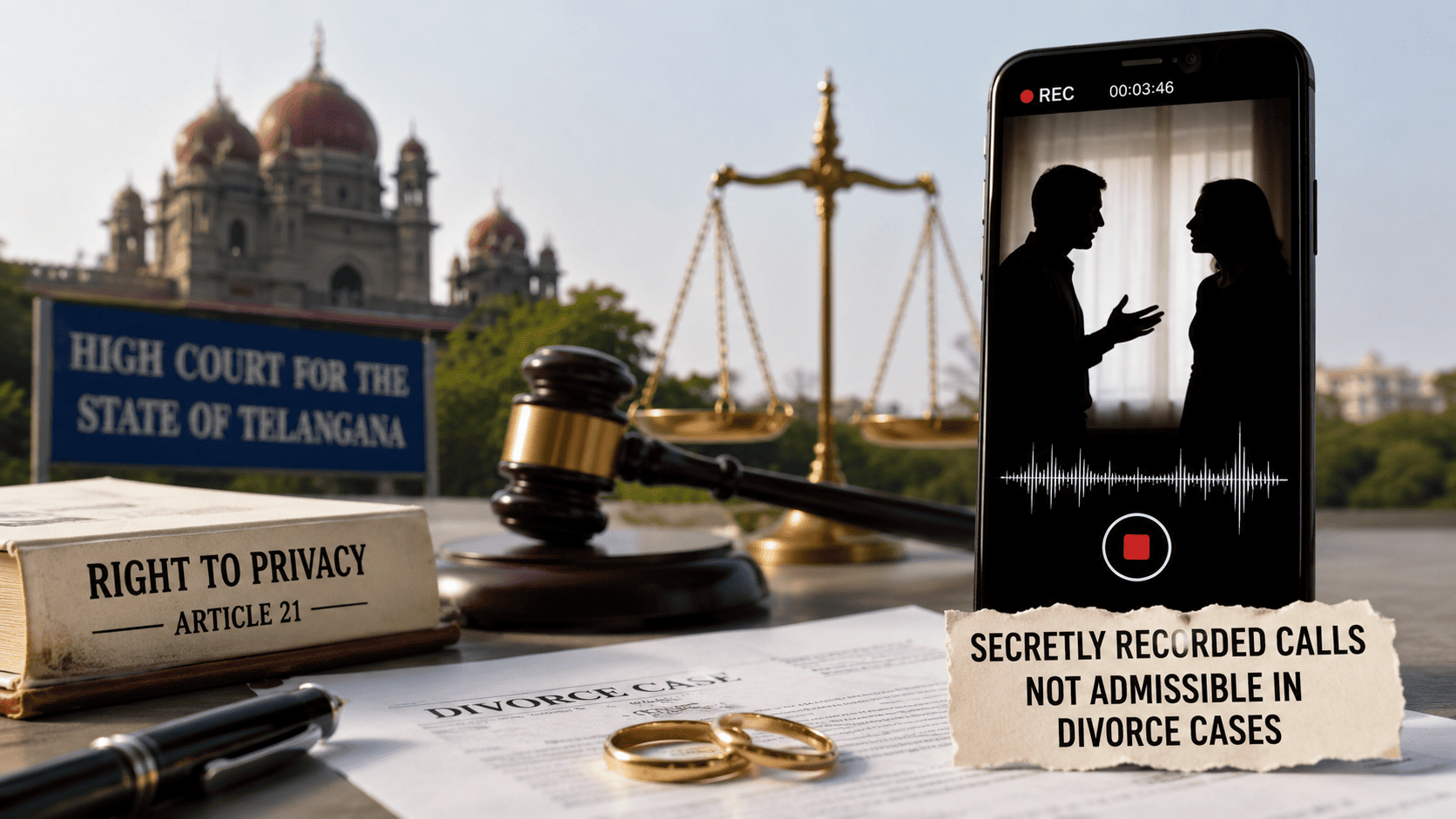
The Telangana High Court has delivered an important judgment concerning the right to privacy in matrimonial disputes. The Court has held that secretly recording a spouse's telephone conversations without their knowledge or consent amounts to a violation of the fundamental right to privacy guaranteed under Article 21 of the Constitution of India.
The Court further clarified that electronic records cannot be admitted merely because they exist in digital form. Every electronic document must satisfy the legal requirements under the Evidence Act and should have a direct connection with the issues involved in the case.
Background of the Case
The case arose out of a divorce petition filed by the husband seeking dissolution of marriage on the ground of cruelty. During the proceedings, the husband sought permission to place several documents before the trial Court, including secretly recorded telephone conversations, medical records, payment receipts, travel tickets, photographs, expenditure details and money transfer records.
The trial Court rejected the applications. Aggrieved by the order, the husband approached the Telangana High Court by filing Civil Revision Petitions.
Secretly Recorded Calls Cannot Be Used as Evidence
The High Court upheld the findings of the trial Court and observed that secretly recording telephone conversations without the consent of the other spouse amounts to a breach of the constitutional right to privacy.
The Court observed that every individual has a legitimate expectation of privacy in personal conversations. Therefore, secretly recording private telephone conversations solely for use in matrimonial litigation cannot be permitted.
Accordingly, the Court held that such call recordings cannot be admitted in evidence when they have been obtained without the knowledge or consent of the other spouse.
Electronic Records Must Also Be Relevant
The Court further observed that electronic evidence cannot be received automatically merely because it is stored in electronic form.
Every document sought to be produced before the Court must have a clear nexus with the issues involved in the case. If the document does not assist the Court in deciding the dispute, its production serves no useful purpose.
Other Documents Did Not Prove Cruelty
The husband had also produced several other documents including medical records, payment receipts, air tickets from the United States to India, family photographs, expenditure relating to travel and money transfer records.
After examining these documents, the High Court found that they did not support the allegations of cruelty. On the contrary, the documents reflected that the parties had shared a cordial and successful married life.
The Court further observed that during a normal marital relationship it is natural for a husband to incur expenses for his wife. Therefore, ordinary financial support, travel expenses or family photographs cannot by themselves establish matrimonial cruelty.
Compliance with Section 65-B Remains Necessary
The trial Court had also noticed that the alleged call recordings were not supported by the mandatory certificate required under Section 65-B of the Indian Evidence Act.
There was no satisfactory explanation regarding the original device containing the recordings or the source from which the electronic records had been generated. These deficiencies further weakened the request to admit the electronic evidence.
Difference from the Supreme Court's Earlier View
An interesting aspect of this judgment is that it differs from the Supreme Court's decision in Vibhor Garg v. Neha (2025), where the Supreme Court had observed that secretly recorded conversations between spouses could be admissible in matrimonial proceedings under certain circumstances.
However, the Telangana High Court adopted a different approach by placing greater emphasis on protecting the constitutional right to privacy guaranteed under Article 21 of the Constitution.
High Court Dismissed Both Revision Petitions
After examining the entire material placed before it, the High Court found no illegality in the order passed by the trial Court.
The Court concluded that neither the secretly recorded conversations nor the remaining documents helped the husband establish his allegations of cruelty. Consequently, both Civil Revision Petitions were dismissed.
Key Takeaways
- Secretly recording a spouse's telephone conversations without consent may violate the fundamental right to privacy under Article 21.
- Electronic evidence must satisfy the legal requirements of the Evidence Act before it can be admitted.
- Every document produced before the Court must be directly relevant to the dispute.
- Ordinary financial support, travel records and family photographs do not by themselves establish matrimonial cruelty.
- The Telangana High Court has reaffirmed that privacy remains an important constitutional protection even in matrimonial disputes.
Conclusion
This judgment serves as an important reminder that while parties are entitled to produce evidence in support of their case, such evidence must be collected through lawful means and must directly relate to the issues before the Court. The decision reinforces the importance of protecting individual privacy while ensuring fairness in matrimonial litigation.
Need Legal Assistance in a Divorce or Family Dispute?
Whether you are dealing with a divorce, child custody dispute, domestic violence proceedings, maintenance, property disputes between spouses, or any other family law matter, our experienced advocates can guide you through every stage of the legal process with practical and reliable legal advice.
Book a Consultation